

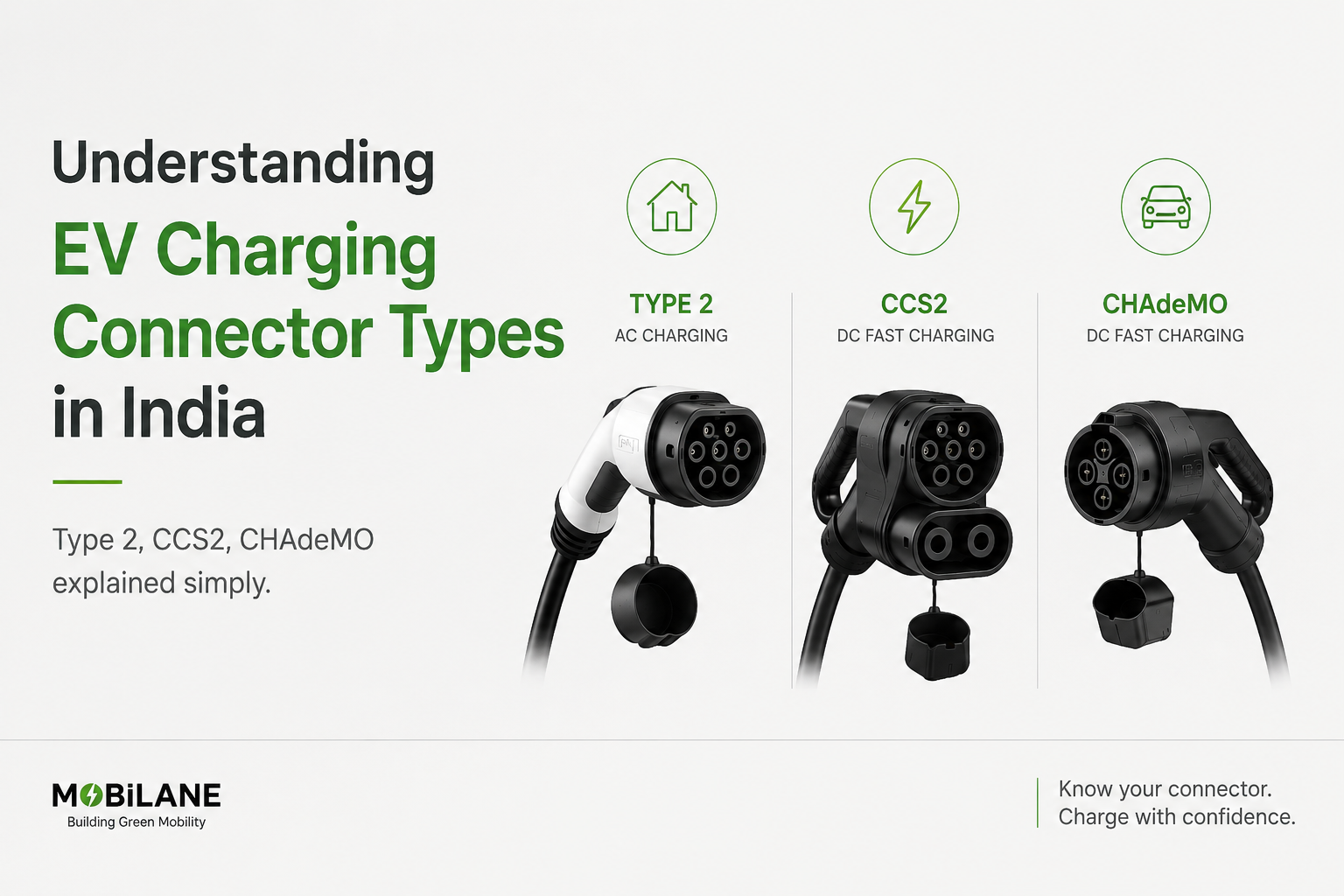
You reach an EV charging station, pick up the charging cable — and realise the connector does not fit your vehicle. For many new EV owners, understanding different charging connectors can feel confusing.
This simple guide explains all major EV charging connector types in India, including CCS2, CHAdeMO, Type 2 connectors, charging speeds, compatibility, and how to find the right charger for your EV.
Quick Answer:
India mainly uses three EV charging connectors: Type 2 for AC charging, CCS2 for DC fast charging, and CHAdeMO for older EV models. Most modern Indian EVs use Type 2 and CCS2 charging standards.
The Three Main EV Charging Connectors in India
| Connector | Charging Type | Power | Common EVs |
|---|---|---|---|
| Type 2 | AC Charging | 3.3–22 kW | Nexon EV, MG ZS EV |
| CCS2 | DC Fast Charging | 30–350 kW | BYD Atto 3, Kia EV6 |
| CHAdeMO | DC Charging | 50–100 kW | Older EV Models |
Type 2 Connector: India’s AC Charging Standard
The Type 2 connector, also known as Mennekes or IEC 62196 Type 2, is the most commonly used AC charging connector in India.
It is widely available in:
- Home EV chargers
- Apartment charging stations
- Office charging points
- Public AC chargers
Type 2 chargers usually support charging speeds from 3.3 kW to 22 kW depending on charger capacity.
Explore MobiLane’s range of compatible EV chargers for different charging needs.
CCS2: India’s DC Fast Charging Standard
CCS2 (Combined Charging System 2) is India’s preferred DC fast charging connector standard for modern electric vehicles.
CCS2 combines the Type 2 AC connector design with two additional DC pins, allowing faster charging through the same charging port.
MobiLane’s DC fast charging network supports high-speed CCS2 charging, helping EV drivers complete long journeys conveniently.
Learn more about DC fast charging vs slow charging before choosing your charging method.
Popular EVs Using CCS2
- Tata Nexon EV
- MG ZS EV
- Hyundai Ioniq 5
- Kia EV6
- BYD Atto 3
CHAdeMO: Older DC Fast Charging Technology
CHAdeMO is a Japanese fast charging connector standard used in earlier electric vehicles.
Although CCS2 is becoming dominant in India, some older EVs still rely on CHAdeMO charging support.
How to Check Which Connector Your EV Uses
- Check your vehicle manual
- Inspect your EV charging port
- Use the MobiLane Spotlight tool to find compatible chargers
- Confirm specifications with your EV manufacturer
Why EV Connector Compatibility Matters
Choosing the correct charging connector ensures faster charging, safer operation, and a better EV ownership experience.
Before long-distance travel, always confirm charger availability and compatibility.
Plan your next EV journey using our EV road trip planning guide .
You can also discover nearby stations using the MobiLane EV charging application .
Frequently Asked Questions
What EV charging connector does Tata Nexon EV use?
The Tata Nexon EV uses Type 2 for AC charging and CCS2 for DC fast charging.
Is CCS2 the standard EV charging connector in India?
Yes. CCS2 has become the preferred DC fast charging standard for modern electric vehicles in India.
What is the difference between Type 2 and CCS2?
Type 2 supports AC charging, while CCS2 adds extra DC pins for high-speed fast charging.
Will CHAdeMO continue in India?
CHAdeMO support will continue for existing vehicles, but newer EV models are mainly shifting towards CCS2.
Which is the fastest EV connector in India?
CCS2 currently supports the fastest charging speeds available for public EV charging infrastructure.
Conclusion
Understanding EV connectors becomes simple once you know the three major standards: Type 2, CCS2, and CHAdeMO.
For most new EV owners in India, Type 2 handles daily AC charging while CCS2 provides fast charging support during travel.
Find The Right Charger For Your EV
Check EV charger compatibility and discover nearby charging stations with MobiLane Spotlight. Check Your EV Compatibility