

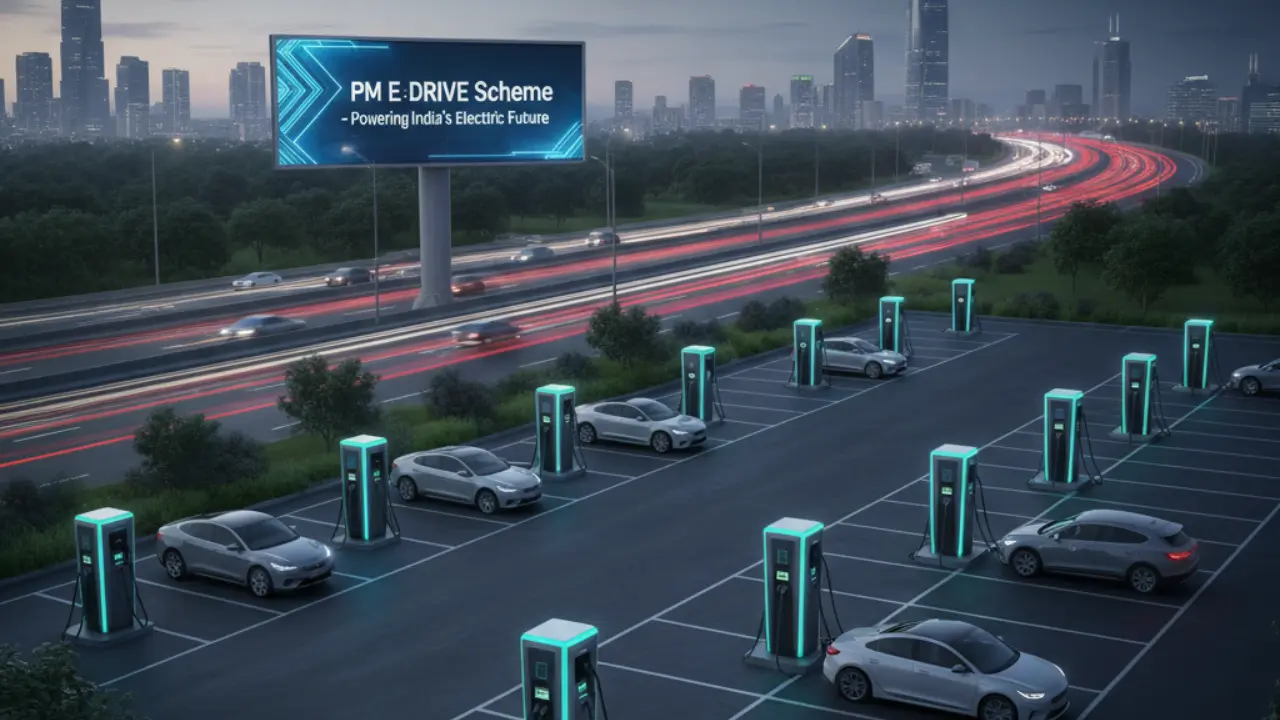
PM E-DRIVE: ₹2,000 Cr Subsidy for 72,300 EV Charging Stations
The Central Government has launched a massive initiative to supercharge electric vehicle (EV) adoption in India, releasing detailed operational guidelines and a revolutionary tiered subsidy structure for the deployment of a staggering 72,300 public EV charging stations nationwide. This strategic move, central to the PM E-DRIVE scheme, is backed by a ₹2,000 crore allocation, setting the stage for a robust, interconnected electric vehicle infrastructure across the country.
This landmark decision aims to decisively tackle ‘range anxiety’ a major barrier to widespread EV acceptance and firmly establish India’s leadership in the e-mobility transition.

A Tiered Subsidy Model: Smart Support for Faster Rollout
The new norms introduce a smart Government subsidy model that varies based on location and public access, ensuring funds are directed where they can maximize impact:
100% Subsidy for Public Access :
Charging points on government premises (offices, hospitals, etc.) will receive a 100% subsidy on both infrastructure and charging equipment, provided they offer free public access.
High Subsidy for Public Hubs
Key publicly owned locations like railway stations, airports, and major retail fuel outlets will benefit from a robust 80% subsidy on upstream infrastructure and a 70% subsidy on EV charging equipment.
Incentivizing Private and Highway Rollout :
General city areas, shopping complexes, and major National/State Highways are also strongly incentivized, receiving an 80% subsidy for necessary upstream infrastructure. Similar support applies to dedicated battery swapping and charging stations.
This targeted approach minimizes financial risk for operators and accelerates private investment in building this essential EV charging station network in Ev market in india.
Implementation and Strategic Focus
To ensure rapid and efficient deployment of the 72,300 charging stations, the government has established a clear implementation roadmap. State and UT governments are tasked with appointing nodal agencies to aggregate demand and identify priority locations.
Crucially, Bharat Heavy Electricals Limited (BHEL) has been designated as the Project Implementation Agency (PIA), underscoring the scheme’s national strategic importance. Subsidy disbursement will follow a performance-linked, two-tranche system to maintain accountability and compliance.
The focus areas for the electric vehicle infrastructure rollout are strategically chosen to maximize connectivity :
– Urban centers with over one million population.
– Smart cities and their satellite metro towns.
– State capitals.
– High-density National and State Highways.
By focusing on these vital corridors, the PM E-DRIVE scheme is poised to dramatically accelerate the growth of the EV sector, ushering in an era of clean mobility and sustainable transportation for India.
Mobilane Spotlight Insight
At Mobilane, we see the PM E-DRIVE Scheme as a milestone for the EV ecosystem. By reducing the financial burden on operators and encouraging private participation, the government is laying the foundation for a truly interconnected charging network.
For EV users, this means more confidence to drive electric—whether commuting within cities or traveling across states. For the industry, it opens opportunities for innovation in smart charging, load management, and renewable energy integration.
As an active player in the EV charging space, Mobilane is excited to contribute to this transformative journey and support India’s vision of becoming an EV-first nation.
For More Updates visit our website: MobiLane Network